
Introduction
Formula 1 represents one of the most demanding environments for automotive engineering, where aerodynamic efficiency, mechanical performance, thermal management, and regulatory compliance must be balanced within a highly integrated vehicle. The 2026 Formula 1 regulations introduced a significant change to aerodynamic design through movable front and rear wing elements, enabling cars to adapt their aerodynamic characteristics to different sections of a racing circuit.
At the same time, teams continue to address the complex relationship between brake cooling, wheel airflow, and tyre temperatures. McLaren’s closely examined 2025 brake-drum design and its circuit-specific brake-cooling development for the 2026 Singapore Grand Prix offer useful examples of these engineering challenges.
This technical brief examines how active aerodynamics and brake thermal management influence Formula 1 vehicle performance, highlighting the roles of Computational Fluid Dynamics (CFD), heat-transfer analysis, mechanical design, and experimental validation.
Understanding Formula 1’s 2026 Active Aerodynamics
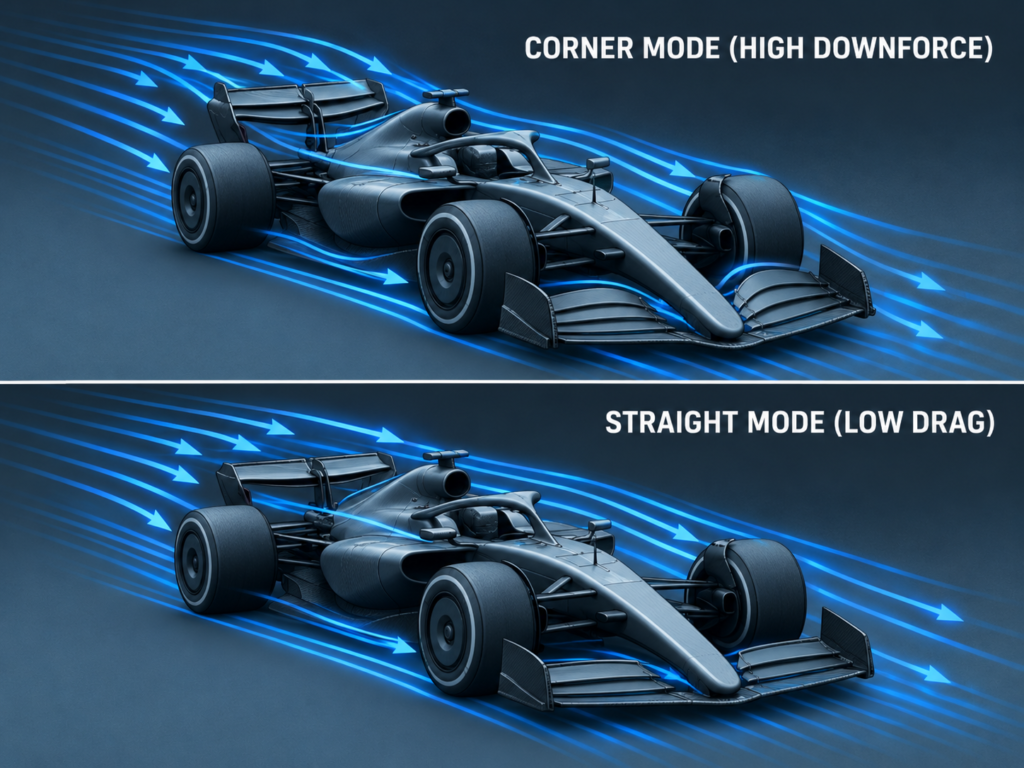
The 2026 Formula 1 regulations introduced active aerodynamic systems that adjust movable elements on both the front and rear wings. Unlike the previous Drag Reduction System (DRS), which primarily opened a rear-wing flap under defined overtaking conditions, the new system changes the aerodynamic configuration of both wings in designated sections of the circuit.
The system operates through two principal configurations: Corner Mode and Straight Mode. In Corner Mode, the wing elements remain in their higher-downforce configuration, helping the tyres generate the grip needed during cornering. In Straight Mode, the movable elements change their angles to reduce aerodynamic drag and improve straight-line efficiency.
These configurations allow engineers to address a fundamental compromise in race-car design. Generating aerodynamic downforce generally increases tyre loading and cornering capability, but it also introduces resistance to forward motion. Reducing drag can improve straight-line speed and energy efficiency, although the associated reduction in downforce must be managed carefully.
Balancing Downforce, Drag, and Vehicle Stability
Aerodynamic downforce is generated by pressure differences and airflow patterns around a racing car’s wings, floor, and bodywork. Greater downforce can increase the available tyre grip, while aerodynamic drag opposes the vehicle’s forward motion and increases the power required to sustain high speeds.
The engineering challenge is not simply to maximize downforce or minimize drag independently. Instead, the objective is to achieve an appropriate aerodynamic balance for each operating condition while maintaining predictable vehicle handling.
When the front and rear wings change configuration, the distribution of aerodynamic loading across the car can also change. Engineers must therefore consider front-to-rear aerodynamic balance, structural deflection, airflow separation, and the interaction between the wings and other vehicle components.
In the 2026 system, coordinated movement of the front and rear aerodynamic elements helps manage these changes. Wing geometry, actuator response, mechanical reliability, and compliance with FIA operating requirements become important considerations in the design process.
Engineering Movable Wing Systems
Active aerodynamic components must operate under substantial aerodynamic loads while meeting strict dimensional, structural, and operational requirements. The mechanical system must reposition wing elements accurately and repeatedly without compromising reliability.
Engineers must evaluate hinge arrangements, structural stiffness, actuator mechanisms, component fatigue, and the forces acting on moving aerodynamic surfaces. Small changes in wing angle can influence airflow behavior, making positional accuracy and repeatability important design considerations.
Computational Fluid Dynamics can be used to investigate pressure distribution, flow separation, drag, and downforce across different wing configurations. Structural analysis, including Finite Element Analysis (FEA), can help evaluate stresses, deflection, and fatigue-sensitive regions under aerodynamic loading.
Wind-tunnel testing and track data provide essential validation. By comparing numerical predictions with measured aerodynamic and mechanical behavior, engineers can refine their models and assess whether a design performs consistently across its intended operating conditions.
McLaren’s 2025 Brake and Tyre Thermal-Management Engineering
During the 2025 Formula 1 season, McLaren attracted considerable technical interest because of its ability to manage tyre temperatures effectively. Attention focused particularly on the team’s rear brake-drum and wheel-area design, where carefully controlled heat transfer may have contributed to favorable tyre operating conditions.
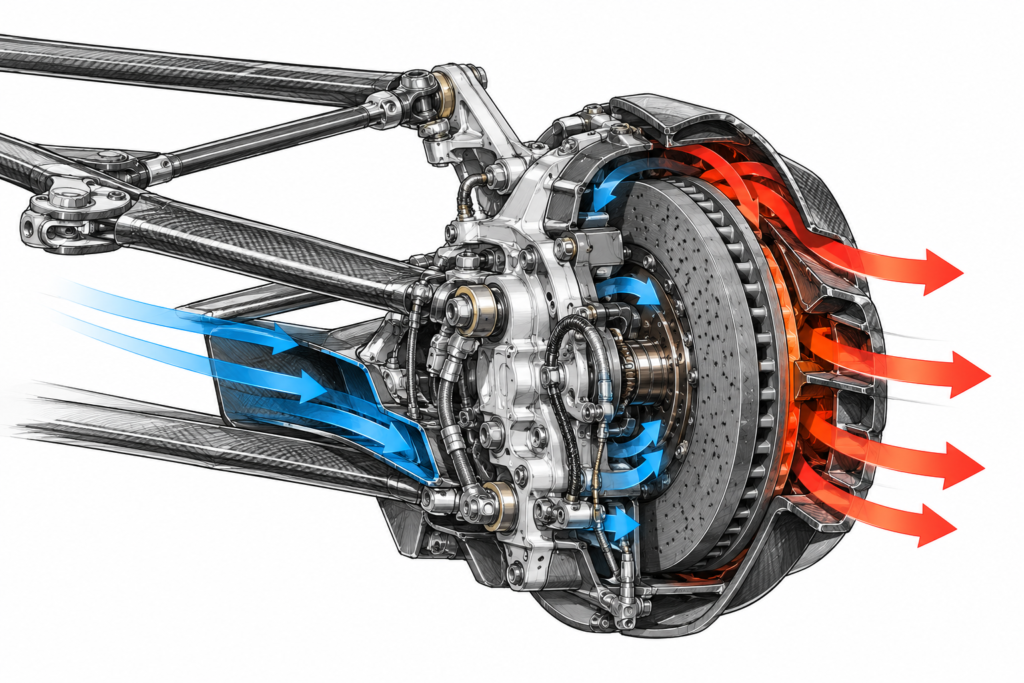
Formula 1 carbon braking systems generate significant thermal energy during deceleration. Some of this heat is removed by cooling airflow, while additional energy can be transferred through conduction and radiation to surrounding components, including the brake drum, wheel rim, and nearby tyre assembly.
Controlling these heat-transfer paths is important because tyre behavior is strongly influenced by temperature. Excessive thermal loading can affect tyre performance and durability, making the interaction between the braking assembly and wheel environment an important area of engineering development.
Technical reporting on McLaren’s 2025 design described sophisticated brake-drum geometry and airflow management. Some observers also speculated about unusual cooling materials or methods, including phase-change materials. However, these theories were not publicly established as features of McLaren’s actual design.
Following detailed inspections in 2025, the FIA found McLaren’s examined brake and wheel assembly compliant with the applicable regulations. The exact internal engineering solution remained proprietary, so claims about its detailed construction should be distinguished from confirmed technical findings.
FIA Regulations and the Evolution of Cooling Strategies
Formula 1 regulations place limits on how teams can control temperatures in braking, wheel, and tyre systems. The 2026 technical regulations clarified and strengthened restrictions on additional tyre-cooling methods, including devices or procedures intended to enhance cooling beyond specified permitted mechanisms.
These changes illustrate how regulatory requirements influence engineering decisions. Teams must develop cooling strategies that satisfy thermal performance targets without introducing prohibited devices or operating methods.
Importantly, the revised regulations do not establish that McLaren’s particular 2025 brake-drum design was illegal or specifically prohibited. Instead, they provide a stricter framework for evaluating thermal-management approaches across the championship.
McLaren’s 2026 Singapore Grand Prix Brake-Cooling Development
At the October 2026 Singapore Grand Prix, McLaren introduced a high-cooling front brake duct configuration designed to address the circuit’s demanding braking conditions. The team identified additional front brake duct scoops and exits as its principal car update for the event.
Singapore presents challenging thermal conditions because of its repeated braking zones and the need to manage heat across successive acceleration and deceleration cycles. Under these conditions, sufficient airflow through the braking assembly becomes particularly important.
McLaren’s revised duct configuration was intended to provide additional cooling airflow to the front braking system. Increasing the available airflow can improve convective heat removal, helping control temperatures in the brake assembly during demanding operating conditions.
However, larger cooling inlets and exits can introduce aerodynamic compromises. Air directed through a brake-cooling system can affect drag, wheel wake, and the flow around nearby suspension and bodywork components. Consequently, the most aerodynamically efficient duct configuration may not provide sufficient cooling for every circuit.
The Singapore development demonstrates a practical engineering trade-off: thermal reliability and acceptable operating temperatures may take priority over minimizing aerodynamic losses. It was a circuit-specific cooling solution rather than a claimed breakthrough in overall aerodynamic performance.
Computational Simulation and Experimental Validation
The relationship between active aerodynamics and brake cooling highlights the importance of multidisciplinary engineering analysis. Both systems depend on fluid-flow behavior, but brake cooling also requires detailed investigation of thermal energy transfer and component temperature limits.
CFD can help engineers predict airflow around movable wings, through brake ducts, and across wheel assemblies. Thermal analysis can estimate heat transfer between braking components and surrounding structures, while FEA can investigate mechanical stresses, deformation, and temperature-related structural effects.
Engineers may also use transient simulations to study changing conditions during braking events and repeated laps. These analyses can help identify localized temperature concentrations, variations in airflow distribution, and potential durability concerns.
Simulation results must be evaluated against experimental measurements. Wind-tunnel testing, temperature sensors, brake instrumentation, pressure measurements, and track telemetry can provide evidence for validating engineering assumptions and refining component designs.
Combining these methods supports a more complete understanding of aerodynamic performance, thermal efficiency, structural reliability, and the trade-offs involved in vehicle development.
Conclusion
The 2026 Formula 1 active aerodynamic regulations demonstrate how movable mechanical systems can help balance downforce and drag across different operating conditions. Their successful implementation depends on coordinated aerodynamic design, reliable actuation, structural integrity, and extensive testing.
McLaren’s brake-cooling developments provide a complementary example of how vehicle performance depends on effective thermal management. The technical interest surrounding its 2025 brake-drum design and its confirmed 2026 Singapore high-cooling duct illustrate the close relationship between heat transfer, airflow management, tyre behavior, and regulatory constraints.
For the broader automotive and mechanical engineering industry, these technologies demonstrate the value of CFD, FEA, material selection, thermal simulation, and experimental validation. The same engineering principles are relevant to high-performance vehicles and other systems where aerodynamic efficiency, heat dissipation, and mechanical reliability must be optimized together.
References
Formula 1 — 2026 Aerodynamic Regulations: 2026 Regulations Explained: All You Need to Know About F1’s New Aerodynamics
Formula 1 — 2026 Technical Terminology: F1 2026 Regulations — Terminology Update
The Race — McLaren’s 2025 Brake System: What FIA Was Checking in Detailed McLaren Inspection
The Race — 2026 Cooling Regulations: The True Aim of F1’s 2026 Tyre Cooling Trick Clampdown
McLaren Racing — Singapore Grand Prix 2026: The Briefing: 2026 Singapore Grand Prix
FIA — Formula 1 Technical Regulations: 2026 Formula 1 Technical Regulations — Section C, Article C10.8.3